


The Australian Standard for Security Doors Explained
Last updated: May 2026
Key Insights
- Genuine security doors must comply with the AS 5039 series (AS 5039.1, AS 5039.2 and AS 5039.3), which replaced older standards AS 5039, AS 5040 and AS 5041.
- A compliant security door must pass six forced-entry and durability tests including impact, knife shear, jemmy and corrosion testing.
- Without compliance to AS 5039 series, a product is not legally considered a security door in Australia.
- Melbourne homeowners should always verify compliance labels, certification documents, locking systems and installation quality before buying.
- My Security Door products meet or exceed Australian Standards, with Crimsafe security doors delivering impact resistance far above minimum compliance levels.
The Difference Between a Real Security Door and a Reinforced Flyscreen
Walk into almost any hardware store in Australia and you’ll find products marketed as “security doors.” The problem is that many of these doors have never actually passed the Australian Standard. Some are little more than reinforced flyscreens, designed to look secure without being independently tested against forced entry. A genuine security door must comply with the AS 5039 series. This is what separates a properly tested security door from a standard barrier screen.
This guide explains what each part of the standard covers, why AS 5039 matters, the six tests a compliant security door must pass, and how Melbourne homeowners can verify whether a product is genuinely compliant before buying.
What Is the Australian Standard for Security Doors?
The Australian Standard for security doors refers to the compliance requirements set out under the AS 5039 series, which includes:
- AS 5039.1-2023 – Classification and performance
- AS 5039.2-2024 – Installation requirements
- AS 5039.3-2023 – Methods of test
These updated standards replaced the older:
- AS 5039-2008 (Design and Manufacturing)
- AS 5040-2003 (Installation)
- AS 5041-2003 (Testing Methods)
This update brought Australia’s security door standards in line with modern testing methods by consolidating all requirements into one unified framework.
Why the Australian Standard for Security Doors Matters
Australian security door standards exist to ensure products can withstand genuine forced-entry attempts. If you’re comparing security doors for your home, it’s important to ensure the products you are considering are properly tested and certified, to avoid buying doors that are not secure.
Many products sold as “security doors” are actually barrier doors, designed primarily for insect protection and airflow rather than resisting forced entry. But without compliance to AS 5039 series, a product is not legally considered a security door in Australia.
Melbourne is known for its “four seasons in one day,” with frequent rain, temperature swings, and varying humidity levels. All these conditions can take a toll on lower-quality materials over time.
The corrosion and durability requirements in AS5039.3:2023 ensure that security screens are tested to withstand environmental stress and coastal conditions, not just look good when installed. High-quality systems like Crimsafe, which use advanced materials and protective finishes, are designed to maintain strength and performance for years, even in demanding conditions.
AS 5039.1: Classification and Performance
AS 5039.1-2023 sets the requirements for how a security door must be designed and perform under testing conditions. This part of the standard governs the structural integrity of the door and ensures all components work together under forced-entry scenarios. It includes security level ratings, SL100 and SL200 which measure how much impact force a door can withstand during testing. An SL100 door must survive repeated impacts of 100 Joules, while SL200 products must withstand 200 Joules of force.
To comply, the door must be manufactured using materials and construction methods capable of passing independent testing. It covers critical areas including:
- Frame strength
- Mesh integrity
- Locking mechanisms
- Corner reinforcement
- Hinges and fixings
- Impact resistance
AS 5039.2: The Installation Standard
Even the strongest security door can fail if it is installed incorrectly. AS 5039.2 specifies the correct installation requirements for compliant security doors and screens. The standard covers:
- Frame alignment
- Fixing methods
- Structural anchoring
- Hinge placement
- Lock positioning
- Gap tolerances
Poor installation can create weak points that allow intruders to:
- Pry the frame away from the wall
- Lift the door from its hinges
- Create gaps large enough to reach locks
- Compromise the strength of the entire system
DIY installations rarely meet AS 5039.2 requirements because compliant installation requires specialist fitting knowledge regarding correct anchoring points, appropriate fixings for the wall type and precise frame tolerances.
Many manufacturer warranties are also void if the product is not installed by a qualified professional. For this reason, installation quality is just as important as the door itself, as it is why My Security Door provides installation by trained professionals free of charge.
The Six Tests a Compliant Security Door Must Pass
AS 5039.3 defines the testing methodology used to determine whether a security door complies with the Australian Standard. These tests simulate the most common forced entry methods used during attempted break-ins.
Here are the six major tests a compliant security door must pass:
This test simulates someone kicking or shoulder charging the door. A pendulum impact device strikes the door repeatedly using:
100 Joules of force for SL100
200 Joules of force for SL200
The impact is repeated five times. The door must remain structurally intact without creating an opening large enough for entry.
This test evaluates how resistant the mesh is to cutting attacks. A heavy-duty blade slices into the mesh three times. In order to pass, the cut cannot exceed 150mm, the mesh must remain retained in the frame and the opening must remain too small for entry
The jemmy test simulates a burglar attempting to pry the door open using leverage. A lever is wedged between the frame and door while a winch applies force. The product fails if the locks disengage, the hinges separate, the frame opens excessively or a large enough gap is created for entry.
The pull test measures how securely the mesh is retained inside the frame. The mesh is subjected to pulling forces of up to 200kg. This simulates an intruder attempting to rip the mesh out of the frame. Inferior retention systems commonly fail this test.
This test checks whether a gap can be opened large enough for a hand or tool to fit through. The probe test is designed to prevent intruders from:
Reaching internal locks
Unlocking the door manually
Manipulating the latch mechanism
The 2023 update replaced the older diamond-grille shear test with a corrosion resistance test. This change reflects the importance of durability in Australian conditions. The corrosion test ensures the product can withstand:
Coastal environments
Humidity
Rain exposure
Long-term weathering
This is especially important for Melbourne homes exposed to varying weather conditions throughout the year.
How to Verify a Security Door Is Actually Compliant
Before paying a deposit, homeowners should verify whether the product is genuinely compliant with Australian Standards. Here is a practical buyer checklist.
- Compliance Label – NSSA members must label compliant products with manufacturer and standard details.
- Certification Documentation – Ask for AS 5039 certification and test reports. No documentation is a red flag.
- Hinges – At least three fixed‑pin hinges to prevent removal.
- Locking System – A three‑point lock (top, centre, bottom) should be standard.
- Cylinder Lock – Minimum 5‑pin cylinder for better resistance.
- Frame Corners – Corners should be welded or reinforced. Weak corners are common failure points.
- Terms like “security style” or “heavy duty screen” often indicate non‑compliant products.
Learn more about what separates a strong security door from a weak one.
How My Security Door Exceeds the Australian Standard
At My Security Door all our security doors meet the AS 5039 series at a minimum and our Crimsafe security doors go even further.
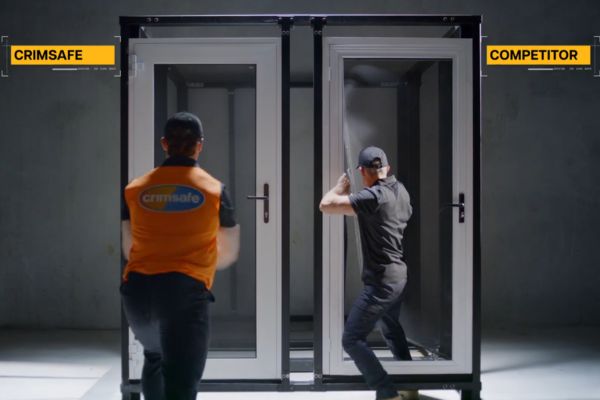
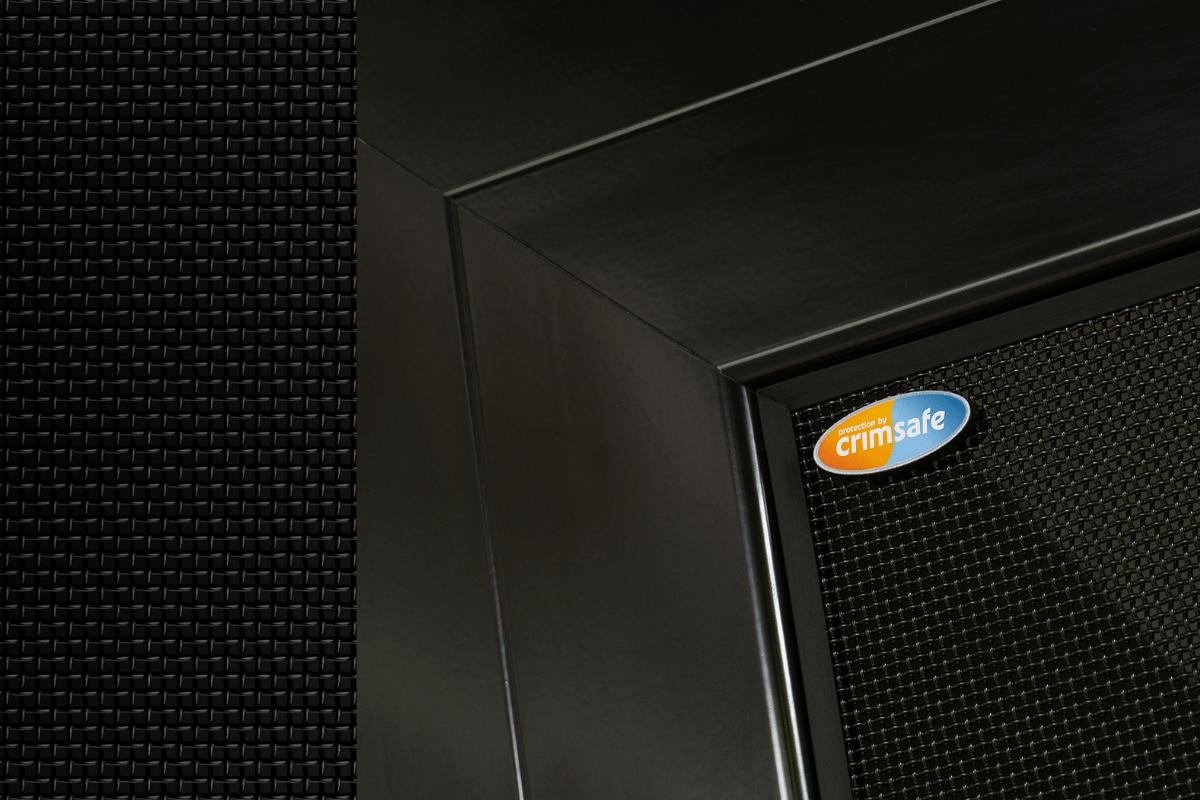
Crimsafe products exceed the Australian Standard by approximately 5 to 7.5 times depending on the product range. The system uses 0.9mm 304-grade stainless steel mesh and this mesh is approximately 26.5% thicker than the minimum required under the standard. Crimsafe also passes the knife shear test comfortably due to its advanced screw-clamp retention system which locks the mesh deep into the frame. For impact resistance, Crimsafe Regular and Classic stand up to 550 Joules of force and Crimsafe Ultimate withstands up to 750 Joules of force. This is significantly higher than the SL100 minimum benchmark.
For Melbourne homeowners wanting maximum protection, this provides an additional layer of confidence well beyond baseline compliance.
Browse our Crimsafe security doors or learn more about Crimsafe security door testing results.
Security Door Australian Standards FAQs
AS 5039 now refers to a series of Australian Standards (AS 5039.1, AS 5039.2 and AS 5039.3) that define how security doors are designed, manufactured, installed and tested.
A barrier door is primarily designed for airflow and insect protection, while a compliant security door has been independently tested against forced-entry attacks.
Most compliant security doors use a three-point locking system because it provides stronger resistance against jemmy and levering attacks.
DIY installation rarely complies with AS 5039.2. Incorrect installation can weaken the door and may void manufacturer warranties.
Look for compliance labels, AS 5039 certification documentation, three fixed-pin hinges and a three-point locking system.
AS 5041 was the original Australian Standard for testing security doors. It has now been superseded and incorporated into AS 5039.3-2023 as part of the updated AS 5039 standard series.
Get a Compliant Security Door for Your Melbourne Home
The Australian Standard exists to protect homeowners from products that only look secure. All our security screens at My Security Door are installed and built to meet or exceed Australian Standards. We specialise in Crimsafe security doors and steel security doors and are a member of the NSSA as well as an Authorised Crimsafe Licensee with over 35 years experience in the industry.
Choosing a compliant, professionally installed door provides real protection, durability and peace of mind.
These articles may interest you...



Book a free measure and quote
What happens next?


